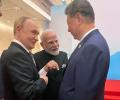
The relations between New Delhi and Washington are on a downturn after Trump doubled tariffs on Indian goods to a whopping 50 per cent, including a 25 per cent additional duties for India's purchase of Russian crude oil.

Saudi Arabia and Pakistan have signed a 'Strategic Mutual Defence Agreement', pledging that any aggression against either nation would be treated as an attack on both.

One key development is the direct cargo connection between Chennai and Vladivostok, a crucial Russian port on the Northern Sea Route.
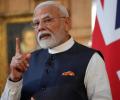
Prime Minister Narendra Modi and his British counterpart Keir Starmer discussed the need to prevent the misuse of democratic freedoms by extremist ideologies. They also addressed terrorism and trade ties.

India and China have held their first diplomatic talks since withdrawing troops from two face-off points in eastern Ladakh, reflecting on the lessons learned from the border row to prevent future incidents. The two sides agreed to maintain peace and tranquillity in border areas, prepare for the next meeting of Special Representatives on the boundary question, and highlighted the importance of regular exchanges and contacts at diplomatic and military levels. The talks come after the completion of the disengagement process from the last two friction points, following an agreement finalized in October 2022.
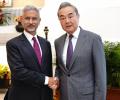
China promised to address three key concerns of India, the sources said.
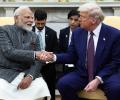
Prime Minister Narendra Modi on Saturday 'deeply' appreciated United States President Donald Trump's 'positive assessment' of the India-US partnership after the American leader hailed the 'special' relationship between the two nations -- remarks seen as an attempt to check the downturn in the ties.

'You cannot 'clear' your way to peace.' 'You need intelligence, calibrated force, impartial law enforcement, political neutrality, humanitarian returns and a sustained reconciliation plan.'
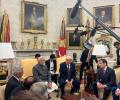
'Trump is not shy when he is frustrated with countries'
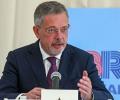
Amidst ongoing efforts to resolve the Russia-Ukraine conflict, Russian Ambassador to India Denis Alipov stated that Moscow is "prepared to sit in a trilateral format" for peace talks. Alipov also expressed optimism about the current US administration's approach to the conflict, suggesting a willingness to engage in dialogue. He highlighted the importance of a peaceful resolution while emphasizing that Russia is prepared to continue the war if necessary. Alipov stated that Russia does not expect anything specific from India in terms of mediation and highlighted the strong bilateral relationship between the two countries.

'What we need to watch is how Saudi Arabia's financial assistance will be used by Pakistan. If the funds go to build their military hardware and operations, it should worry us.'

US Vice President J D Vance and his wife Usha arrived in Delhi on Monday for a four-day visit. They were welcomed by Union Minister Ashwini Vaishnaw. Vance's visit comes amid ongoing trade talks between India and the US. Prime Minister Narendra Modi will host a dinner for the Vances on Monday evening after holding talks with the US Vice President. Vance and his family will also travel to Jaipur and Agra during their trip.

US Vice President JD Vance and his family began their four-day trip to India with a visit to the Swaminarayan Akshardham Temple in Delhi. The Vances, along with their three children dressed in Indian attire, spent an hour at the temple, admiring its intricate architecture and receiving a traditional welcome. The visit comes amid ongoing trade negotiations between the US and India.
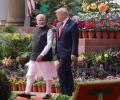
Prime Minister Narendra Modi will visit the US for a two-day working visit starting Wednesday. He will meet with President Donald Trump and engage in bilateral discussions on trade, investment, technology, defense cooperation, counterterrorism, Indo-Pacific security, and people-to-people relations. The visit is expected to further strengthen the India-US partnership.

Describing the Indian Ocean as a living testament to long-standing ties between the Maldives and India, Maldivian President Mohamed Muizzu has said that the two nations have forged a resilient and unbreakable bond that extends far beyond diplomacy.
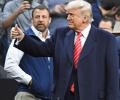
Strategic affairs experts express concern over US President Donald Trump's tariffs on India, his 'bullying tactics,' and increasing attempts to hyphenate New Delhi with Islamabad, signaling a potential shift in the bilateral relationship.

India and China on Wednesday held 'constructive' and 'forward-looking' diplomatic talks to resolve the over four-year border standoff along the Line of Actual Control (LAC) in eastern Ladakh but there was clear no indication of any breakthrough.
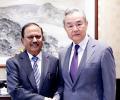
Wang is travelling to India days ahead of Prime Minister Narendra Modi's planned trip to the Chinese city of Tianjin to attend the annual summit of the Shanghai Cooperation Organisation.
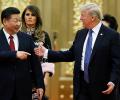
'We have incredible cards, but I don't want to play those cards.' 'If I play those cards, that would destroy China.'
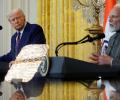
The deal fell through over unresolved disagreements over contentious issues, mainly on agriculture and automotive sector tariffs.

Asked about the recent meeting between Modi and Xi, and if Russia had any role in it, Alipov said, "We have not played any role in it, but we are happy that it took place in Kazan... We wholeheartedly welcome the meeting."
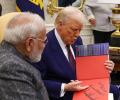
'The current strain in the relationship is serious and likely to be long lasting.' 'Even if Trump suddenly changes his attitude toward India -- which he is entirely capable of doing -- it is unlikely that New Delhi will be able to pick up the pieces and respond as if nothing has happened.'

India and China held talks in New Delhi to discuss the lessons learned from the eastern Ladakh military standoff and prevent its recurrence. The two sides also prepared for the next meeting of the Special Representatives on the boundary question. The talks took place under the framework of the Working Mechanism for Consultation and Coordination on India-China Border Affairs (WMCC). Both sides highlighted the importance of regular exchanges and contacts at diplomatic and military level to maintain peace and tranquility in the border areas.
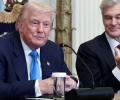
US President Donald Trump announced a deal with Pakistan to develop its oil reserves, suggesting Pakistan might sell oil to India in the future.
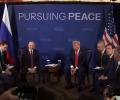
Trump's one-on-one meetings with Putin during his first term were clouded with mystery. With only a translator inside the room, it was often unclear what exactly was discussed. Aides had a difficult time ascertaining if the two reached any agreements. After one such meeting, in Germany, Trump asked his interpreter to discard his notes.
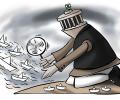
A team of US officials is expected to visit India in the coming weeks for the next round of discussions on the proposed interim trade agreement between the two countries, sources said. The visit gains importance as India and the US are likely to agree on an interim trade agreement before July 9, with New Delhi pushing for full exemption from the 26 per cent reciprocal tariff on domestic goods.

External Affairs Minister S Jaishankar is set to hold separate bilateral talks with his Chinese counterpart Qin Gang and Russia's Sergey Lavrov at a beach resort in Goa on Thursday on the sidelines of a conclave of the Shanghai Cooperation Organisation (SCO) amid rapidly evolving regional security situation.
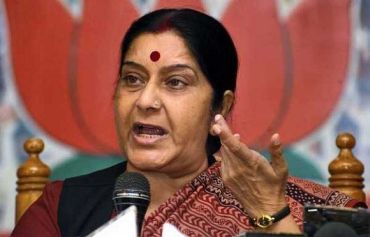
The India-Pakistan ties nose-dived in recent years with no bilateral talks taking place. The ties between the two countries had strained after Pakistan-based terror groups launched attacks in India in 2016.

Though he does not know what New Delhi is intending to do, Berlin would "welcome any engagement", he added.

'The US slump could hit our hosiery market hard since 40 per cent of our exports go there.' 'Job losses could be severe if the government doesn't step in fast.'
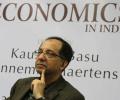
Former World Bank Chief Economist Kaushik Basu on Thursday said the US economic policy towards India has taken an unfortunate turn, noting that President Donald Trump's harsh stance against New Delhi appears baffling. US President Donald Trump on Wednesday announced a 25 per cent tariff on Indian goods from August 1, amid signs of a stalemate in the ongoing bilateral trade negotiations between the two countries.
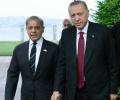
Pakistan Prime Minister Shehbaz Sharif met with Turkish President Recep Tayyip Erdogan to review bilateral relations and reaffirm their commitment to strengthening their strategic partnership. The two leaders discussed joint ventures and enhanced bilateral investment in key sectors, aiming to achieve a $5 billion annual bilateral trade target. They also expressed gratitude for mutual support during recent tensions with India. The meeting was described as "warm and most cordial," highlighting the deep-rooted historical ties between Pakistan and Turkey.
US President Donald Trump has announced a 25 per cent plus tariff on India from Aug 1. Trump, describing India as a "friend", said the US has done relatively "little business" with the country because of its high tariffs.

"We are waiting for our good friend Modi and best regards to him," the Russian media quoted Putin as saying in the meeting with Doval.
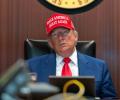
United States President Donald Trump said a 'very big' trade deal is on cards with India, hinting at significant progress in the negotiation process of a long-awaited bilateral trade agreement between the two countries.
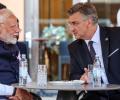
In his media statement following talks with his Croatian counterpart Andrej Plenkovic, Modi said both leaders agree that "terrorism is an enemy of humanity" and is inimical to forces that believe in democracy.

India on Thursday signed a free trade agreement, officially dubbed as the Comprehensive Economic and Trade Agreement (CETA), with the UK - its 16th trade pact so far - as the country aims to boost bilateral trade and investments.
India and the US are likely to agree on an interim trade agreement before July 8 with New Delhi pushing for full exemption from the 26 per cent reciprocal tariff on domestic goods, an official said. The US on April 2 imposed an additional 26 per cent reciprocal tariff on Indian goods but suspended it for 90 days till July 9.

'The Alaska Summit made me realise that while difficult, peace is within reach.'

India-US relations, like Rome, were not built in a day, nor can they be demolished in a day.
All said and done, when the new global order emerges, India can only remain with the democracies, asserts Ambassador T P Sreenivasan.
